Wednesday, December 20, 2006

Web hosted applications

One of the things that helps support my position of having real honest-to-goodness local applications and not depending upon web hosted applications:

Google    
Error
 

Server Error

The server encountered a temporary error and could not complete your request.

Please try again in 30 seconds.

This happened several times over the period of an hour or so last night as I tried to work on a blog post.

Not being able to get to my work environment really bothers me, especially when the availability is totally out of my control and there's no useful information about what to do about it, when it's going to come back or even what, exactly is going on.

Yes, similar things can happen on my laptop (an OS crash, a bad disk, etc.) but at least I feel like it's under my control and that I need to do something to get it working again (rather than being totally at the mercy and whim of the internet gods).

Note also that I'm not picking on Google or Blogger -- just pointing out a serious drawback in the web hosted application model (at least in my point of view). Google the web search engine definitely seems to have this problem solved as I can't remember ever gotten an "unavailable" problem trying to do a search (although my way-too-much time spent on airplanes still means I won't rely on web applications for mail, word processing, etc.).

Tags : / / / /

Tuesday, December 19, 2006

Identity in the news..

Earlier today, Paul "it's not about the page hits" Madsen was bragging to me about his 574 hits yesterday (far exceeding my peak of 393 thanks to that wonderful identity video -- all because he mentioned the new NBC show Identity in his "Be Prepared" blog entry.

Perhaps I can snarf some of the popularity as well :-). Although I do have to admit that his Samuel and URI comments added much more value to the conversation that my simple "hey, come my way too" begging :-).

Tags : /

Gadget of the Week #6

At last weeks Liberty Alliance Technology Expert Group F2F in Portland (which we hosted at Intel), I took a few of my fellow travelers over to the Intel store on campus so they could buy some Intel knick-knacks to bring home to the family. What we found there wasn't as geeky as some of my other gadgets, but very useful for international travellers...

An inexpensive (just $8.99), compact universal international plug adapter.

This one adapter works pretty much anywhere, and can be reconfigured like a transformer (the toy) to adapt to European and UK type plugs:

The sad part about this was that I was unable to find any marking/branding on the adapter to identify a source for it outside of the Intel Store (Sorry folks). I was able to find what looks like another plug designed the same way (can't say who copied who or even whether or not they are manufactured by the same, I'm sure Chinese, company). The closest one I have been able to find is an APC Universal Plug Adapter which you can buy for $15 to $30 at various places.

It's much better than the clunky adapters I've been using to date.

I should note that this is just an adapter. It is not a power transformer. You must have a power supply capable of handling 50-60 Hz and 110-240 Volts. Most portable electronics power supplies can do this nowadays, but you should check the power supply to make sure. There should be a label on the power supply or charger that looks like:

If you don't have such a range of inputs for your device, you will need a transformer (the power kind) in many/most foreign countries.

Tags : / / / / / /

Monday, December 18, 2006

Federated Authorization #3

In my previous article on Federated Authorization, I wrote:

In any case, I think there are problems with the basic premise of federated authorization. If you look closely at the various posts in regards to this question, they all talk about how you can do remote or delegated authorization. This is typically done in a model where an enterprise or service company will have some central authorization service that maintains the set of rights that their customers have.

This isn't a federated solution in that the decision as to the rights afforded the user is not delegated to a foreign entity. Even in the shibboleth model, where a student at university A is granted access to a resource at university B, the authorization decision is made by university B (yes, it's based upon the federated data that the student is a student at university A, but the authorization decision is made by university B).

And James McGovern commented with a question:

I posted in subsequent postings real scenarios where authorization is federated. Shekhar Jha had also chimed in on those which provided a good perspective. Did you get an opportunity to check out the scenarios I posted?

Referring, I think, to these articles:

Consumer Perspectives on Federated Authorization, Federated Authorization and Relationship, and Even More thoughts on Federated Authorization...

These all bring out good examples of some form of delegated authorization (and in the consumer use cases, what I would call federated authorization since you are likely crossing security domains).

While I think that many, if not all, of these use cases are interesting, I think that the model has some issues that prevent its widespread adoptions including:

  • The range of settings for permissions at any one resource controller are vastly different from one instance of that type of resource to another, thus substantially raising the complexity of any centralized management infrastructure.

    For example, given the "authorize my lawyer to pay my insurance bill" scenario, I not only have to authorize him access to my bank account, but to extract money for a particular purpose and probably with some limits on the amount. How also do I differentiate between paying a bill and paying a co-payment or deductable?.

  • The complexity for a good user understandable interface for interacting with such settings. I just don't think that we're even close in the realm of computer/human interfaces to provide a generic mechanism that will allow a central server to have the knowledge and understanding to walk the average technologist through the process. less alone my mother.
  • There are a lot of privacy considerations around a centralized authorization entity (much more so than a centralized identity entity). This one entity will not only control all of my authorizations, but will also have the knowledge of what authorizations I have made. In the early days of the Liberty Alliance work, much thought and energy went into minimizing the knowledge of central parties -- that's why we have segregated service instances into groups of related data (rather than one know-all service provider), that's why we don't have the IdP involved in every message from a Web Service Consumer (WSC) to a Web Service Provider (WSP)(yes, through the Discovery Service (DS), the IdP can know that WSC wanted to talk to a particular WSP, but whether or not they spoke and what they spoke about is not visible to the DS nor the IdP.
  • Doing authorization remotely can have a significant negative performance impact. This comes from the messages necessary to obtain the Authorization information, the caching of said information (without some form of caching, you're really in the dog house of performance) and the parsing of said information on each access. An internal authorization solution can be optimized for the resources being accessed and even tied to said resources within the internal database of the application. Such tight coupling is very hard to do, if not impossible, when receiving authorization statements from remote parties.

Shekhar also pointed out the "Authorization Push" model which has the same issues plus the issue of somehow figuring out at push time, the policies that the recipient will be interested in. I tend to favor push models when the information necessary at the recipient is easily known in advance. With complex authorization policies, the only way to support push would be to push the entire policy -- something that can be very expensive from a bandwidth and processing overhead point of view.

Another problem with the push model is that it assumes a single identity in the interaction. However, when I go to access Paul's photo service, its his service that needs to get the authorizations from his authorization pool, not from mine. I don't think push works in that environment

I'm not normally the pessimist... I just think that in this case, a distributed authorization model is a much better solution. Tight, application specific authorizations (such as "can James add a comment to this article on my blog") are kept with the resources being authorized. Loose, granular, cross-application authorizations (such as "can James see my blog") are more suitable for some level of centralization.

Tags : / / / / / / /

Gift Cards or Cash... that is the question?

I was out Christmas shopping with my wife over the weekend and she was looking for a gift for our kids' teachers. For some, she selected a Barns & Noble gift cards and for others she selected Starbucks gift cards (mostly based on what stores she thought would be close).

My first thought is why not just give cash. Cash is definitely much more portable in that you can use it anywhere. Cash also retains its value forever (many gift cards start to lose value after 6 months to a year). And, Cash usually isn't misplaced in a drawer somewhere -- the recipient usually just puts it directly into their wallet/pocket.

But, there seems to be a negative aura around giving cash. Like the giver has put more thought into the present by selecting a store wherein the recipient is restricted for any purchases. Somehow the fact that the giver likely spent time waiting in line (and getting the people behind her to grumble when the cashier took so long figuring out how to charge up the gift card).

But this negative aura isn't everywhere. For weddings, it's usually fine to give cash. But for birthdays and especially for Christmas (or other holidays) there seems to be a some social drive to not give cash.

For me, you can feel free to just give me cash for any celebration. I'll never look down at receiving cash. In fact, I'd say it's preferred in many cases as nobody else can figure out the things I really need like I can :-).

Not that I'd look down at receiving a gadget either.

Tags : / / / / /

Saturday, December 16, 2006

Almost free software...... NOT!

Over the past few days I've received a rash of offers for unbelievable pricing on various products including Microsoft Office, Vista, Adobe Acrobat, etc..

Clearly this is another SCAM attempt to rip off the user that you need to be very careful to NOT succumb to.

The mail has two basic subject lines:

At Dylan's webshop get 0ffice 2OO7, Acrobat 8 pro & ms-vista under 8O
ACR0BAT 8 PR0 & 0FFICE 2OO7 $79 N0W at Jingbai's WebShop

Although the name changes with every spam (Dylan, Karl, Gary, etc.) and looks like the following (note that I purposely broke the links so that they were not easily clickable -- no need to advertise for them):

All Titles 0n S@le.

Micr0s0ft Vlsta 2OO7     $79 
Micr0s0ft 0ffice 2OO7    $79 
Ad0be Acr0bat 8 PR0   $79 
Wind0ws XP PR0 +SP2   $49 
Ad0be Premiere 2.O   $59 
Macr0media Studi0 8  $99 
Micr0s0ft Money 2OO7     $39 
Aut0desk Aut0cad 2OO7   $129 
C0rel Grafix Suite X3   $59 
Ad0be Creative Suite CS2 $149
Ad0be Illustrat0r CS2  $59 

http  ://rp1207.tuhloem.com/

See more:Micr0s0ft-Mac soft-Ad0be 

Micr0s0ft Vlsta 2OO7
Normal Price:  $399.00
0ur 0ffer:  $79.95
U-save:  $319.95 (75%)
Availability: Pay-and-download instantly.

http  ://rp1207.tuhloem.com/???.php

SalesRank: #1
Average Customer Review: *****
(based on 60465 reviews)

Micr0s0ft 0ffice 2OO7 Enterprise
Normal Price:  $899.00
0ur 0ffer:  $79.95
U-save:  $819.95 (89%)
Availability: Pay-and-download instantly.

http  ://rp1207.tuhloem.com/???.php

SalesRank: #2
Average Customer Review: *****
(based on 48341 reviews)

Ad0be Acr0bat 8.O PR0
Normal Price:  $449.00
0ur 0ffer:  $79.95
U-save:  $369.05 (80%)
Availability: Available for INSTANT-download.

http ://rp1207.tuhloem.com/???.php

Topten-ranked item.
Average Customer Review: *****
(based on 51489 reviews)

Macr0media Studi0 8
Normal Price:  $999.00
0ur 0ffer:  $99.95
U-save:  $899.05 (90%)
Availability: Can be downloaded-INSTANTLY.

http ://rp1207.tuhloem.com/???.php

Best choice for professional.
Average Customer Review: *****
(based on 52823 reviews)

rdist-1.3alpha rdist-1.3a     no strings like `alpha' allowed
o   Each nx= entry matches another gettytab capability name
C> XCOPY /S E:\FLOPPIES C:\FREEBSD\FLOPPIES\
  add 0 0 HISADDR
dispense with making the cua* devices.
 finished with bus, it de-asserts the DRQ line, and the DMA
editing the file /etc/host.conf. Do not call this file /etc/hosts.conf

I base my claim that this is a SCAM on the following factors:

  • TANSTAAFL - There Ain't No Such Thing As A Free Lunch -- the prices are just too good to be true.
  • The names of the products are all changed slightly (zeros for an O, mixed casing, etc.).
  • The products are only available via download -- these vendors frequently do not sell their products via download.
  • I checked the domain registration (using Network Solutions Whois server at http://www.networksolutions.com/whois/index.jsp):
    PacNames WHOIS Server Version 1.1.0
       Domain name: TUHLOEM.COM
       Registrar: PacNames
       Referral URL: http://www.pacnames.com/
       Domain Registrant: (Private Contact) (pws.4441a12478c3e85@shieldedwhois.com)
          Shielded Whois
          Shielded WHOIS
          PO Box 2076
          Arvada CO 80001
          US
          Telephone: +1.5016348793
          Fax:
       Administrative, Technical Contact: (Private Contact) 
    (pws.4441a12478c3e85@shieldedwhois.com)
          Shielded Whois
          Shielded WHOIS
          PO Box 2076
          Arvada CO 80001
          US
          Telephone: +1.5016348793
          Fax:
       Name Server: NS1.SRUL5.COM
       Name Server: NS2.SRUL5.COM
       Domain creaton date: 2006-12-15 18:22:36.0
       Domain expiration date: 2007-12-15 23:38:37.0
    
    This has several issues for me including:
    • It was only registered a few days ago (12/15/2006) - definitely a sign that they haven't been in business long -- something that should raise red flags.
    • The domain registrant used a shielded registration (where their actual name and address is hidden) -- something that's OK for an individual to use, but never used by a legitimate business.
  • I have received more then 30 different versions of this email in the past week all from different senders with a variety of domains in the link including:
    • otkudadeti.com
    • goloem.com
    • tuhloem.com
    • whichinfect.com
    • ispesti.com
    • votivse.com
    • nuujepoh.net
    • her-oem.com
    • hlopai-oem.com
    • hlopai-oem.net

    Yes, all of those domains have been seen on different versions of the same email.

  • The email had a bunch of anti-spam filter stuff in it to get it by spam filters. Legitimate emails typically do not go to such extents. This includes, slight changes in the names of the products in different emails, a bunch of junk at the end of each message that was random garbage designed to foil anti-spam filters.

This feels like the same SCAM that I wrote about in Vacation Photos, but I have no evidence to tie the two SCAMs together other than my gut feeling.

This is a mail that should be ignored and deleted as soon as you get it. Ordering something from their site is the equivalent to having some guy walk up to you on the street asking for your credit card information for a fake rolex watch hanging inside his pocket. None of us would do that (at least I hope we wouldn't) and none of us should follow through on this SCAM either.

If you do/did fall for this offer, at the very best, you most likely get illegal software that you have no rights to use. At the worst, your identity is stolen and you spend several months trying to repair your credit history. I don't know which they are trying to do, but I'm pretty sure it's not something good for you.

UPDATE: 12/20/06 I've been getting a spate of these advertisements for Windows Vista for the same $79 price:

The most comprehensive edition of Windows Vista, Vista Ultimate Upgrade (DVD-ROM) is the first operating system that combines all of the advanced infrastructure features of a business-focused operating system, all of the management and efficiency features of a mobility-focused operating system, and all of the digital entertainment features of a consumer-focused operating system. For the person who wants one operating system that is great for working from home, working on the road, and for entertainment, Vista Ultimate is a no-compromise operating system that lets you have it all. Windows Vista Ultimate contains a number of new features, the most notable of which are: Windows Vista Ultimate combines all the features of a business-focused operating system, all the efficiency features of a mobility-focused operating system, and all of the digital entertainment features of a consumer-focused operating system; Remotely connect to business networks; Windows BitLocker Drive Encryption provides improved levels of protection against theft for your important business data whether you are at home, on the road, or in the office; Delivers all of the entertainment features available in Vista Home Premium; includes everything you need to enjoy the latest in digital photography, music, movies, analog TV, or even HDTV; Upgrade from your current edition of Microsoft Windows XP or Windows 2000 (including Windows XP Professional, Windows XP Home, Windows XP Media Center, Windows XP Tablet PC, Windows XP Professional x64, Windows 2000)
Windows Vista Ultimate Upgrade (DVD-ROM)
Retail Price $399.00
Our Price $79.95
You save $319.05
http://grinolt.com
Please note, that there will be more special offers available for our constant customers. Every effort has been made to ensure the accuracy of all information contained herein. DS Team makes no warranty expressed or implied with respect to accuracy of the information, including price, product editorials or product specifications. Product and manufacturer names are used only for the purpose of identification. We appreciate your cooperation with us and we'll be glad to see you as our clients in the future.

If you go to grinolt.com, you see what looks like a detailed page on Windows Vista. If you lookup grinolt.com in the WhoIs database, it looks like it's owned by a "gwynne bontempo" in New Jersey. However, if you look at the link in the add-to-cart button, you see it brings you to yoroem.com which is owned by our old friend "Alex Rodrigez" of Vacation Photos fame and, in my eyes, clearly linking all these scam emails together.

I recommend you stay way from these guys. A deal that sounds too good to be true is too good to be true, especially if coming from someone trying that hard to hide their tracks.

Tags : / / / / / / /

Friday, December 15, 2006

Federated Authorization

Last week, James McGovern posted comments on a number of blogs trying to stir up some conversation around the concept of federated authorization. There were several responses including one from Pat, Paul, Pat again, Gerald, and myself.

The comment was simply:

Does Federated Identity sometimes require Federated Authorization? Would be a great topic for your next blog entry...

A seemingly simple question. James followed up with his own post making it look like we were responding to some article he wrote on his blog and claiming he already new the answer to that question, but what he really meant was:

The perspective that I was actually seeking wasn't the architecture viewpoint but more of why industry thought leaders aren't talking about authorization and the over-abuse of the term identity management as a catch-all term and how these two problem spaces should become coupled in terms of the conversation.

I'm not sure how anybody could have gotten that out of the question above.

In any case, I think there are problems with the basic premise of federated authorization. If you look closely at the various posts in regards to this question, they all talk about how you can do remote or delegated authorization. This is typically done in a model where an enterprise or service company will have some central authorization service that maintains the set of rights that their customers have.

This isn't a federated solution in that the decision as to the rights afforded the user is not delegated to a foreign entity. Even in the shibboleth model, where a student at university A is granted access to a resource at university B, the authorization decision is made by university B (yes, it's based upon the federated data that the student is a student at university A, but the authorization decision is made by university B).

I think that is a common model and I don't see companies giving up the rights to authorization to foreign entities.

That said, I do see the value and benefit of having support for an remote authorization service, especially in an environment where there are many customers with many different levels of authorization at many service endpoints. The diagram below is from a presentation I made in October of 2005 at a Liberty Alliance workshop in Tokyo, Japan.

The issues around setting this model up are non-trivial. Essentially you need to be able to, on a service-by-service basis, define a set of knobs controlling access rights to each service and the valid range for those knobs (for example, an internet radio service might have knobs controlling the number of stations that are available to the user, the quality of those stations, and the number of endpoints from which they may listen simultaneously).

This type of model allows separation of the package definition (a sales/marketing issue) from the implementation of the service access (a development issue). The sales team can change packages fairly easily without impacting the development team (unless, of course, they need a new knob). This does put a lot of onus on the design of the knobs such that they allow the sales team to develop the appropriate service packages, but it's a big win when done correctly.

In an enterprise, this solution will present the same set of issues that come up with any RBAC implementation - the multitude of roles that need to be managed and the individual approvals necessary to allow the addition of access rights to a particular service within the enterprise. I think it's still doable with the knobs/settings paradigm, but given the "need to know" controls necessary for the privacy of employees and the protection of corporate trade secrets, the result is a vast multitude of yes/no knobs.

Tags : / / / / / / /

Wednesday, December 13, 2006

Merry Christmass

A geeky Christmas Card from a colleague at Intel.

Happy holidays to all!

Tags :

Tuesday, December 12, 2006

Crystal Blue Persuasion

I'm glad Jeff doesn't bring this along with him to our Liberty Alliance meetings. I might not survive...

Tags : / /

Monday, December 11, 2006

Hypocritical?

Today's USA Today (yeah, I read it and prefer it when I'm on the road -- which is pretty much all the time) had an article about the "Gray Market" for electronics her in the USA. Essentially the retailers in the gray market, purchase electronics in other countries where they are cheaper and then re-sell them in the USofA at a lower price than the normal retail products.

Vendors, such as Nikon, don't like this and fight it, primarily by refusing to perform warranty repairs (and some refuse to provide *any* repairs)

I tend to always buy electronics with USA warranties. The prices for the gray market equivalents at reputable vendors don't justify the lack of warranty. Even at one of the most reputable camera dealers, B&H Photo, where they typically price both gray and USA market versions of the same product, I've always picked the USA product.

I find it quite hypocritical that these same companies feel it is their right to shop around the world for cheap labor for their manufacturing while they try to prohibit their consumers from doing the same.

I think it would be interesting if any vendor that used a global labor force had to live by a global pricing model (and therefore, support warranties on even gray market materials).

Tags : / / / / /

Sunday, December 10, 2006

Collections #2...

In my ongoing task to educate the less fortunate as to the world of Harley Davidson (and how H-D is able to make lots of $$ even when they aren't selling me a bike -- as I like the one I have just fine), here's my latest addition to my shirt collection:

This is, of course, one of the better type of dealer-logos, especially for an Irishman like myself. Even better, the bike in the logo is a red Road King Classic - the exact bike that I own.

The shirt (not the bike) was purchased at O'Toole's H-D up in Wurtsboro, NY (when I was up in NY visiting my parents for Thanksgiving a couple of weeks ago).

I'll continue to post new logos as I add to my collection :-).

Tags : / / / / /

Gadget of the Week #5

The advent of the Universal Serial Bus (USB) was a lifesaver for many of us -- not because it is this great communications interface that replaced serial and parallel ports and enabled those wonderful hot-pluggable disk/flash drives, but because it provides a good power source to recharge the myriad of portable electronics that we seem to be carrying nowadays.

This week's gadget is a retractable USB adapter system from Gomadic which allows a single retractable USB cable to power all of my portable electronics through the use of swappable tips.

This sure beats my old system of different retractable cables for each device, although I think life would be much simpler for me as a user if they had standardized on the mini-USB connector to connect to the retractable cable, but I guess that would have made their plugs compatible with other cables.

As you can see, I've already gotten the connector for my new 4GB Clix so I don't have to carry around the proprietary IRiver cable (which wasn't even retractable).

One thing that was surprising was that there were no tips for Nokia devices. Not sure why as I have other USB based cable systems for charging Nokia phones. Seems like an interesting choice of vendor to not support.

Tags : / / / / / /

Saturday, December 09, 2006

Is it the Cahill Blood?

My wife is sure it is. I'm not sure I can argue with her and I'm pretty sure most of the people that know us would agree -- especially if they've met my father as well.

This morning my wife, who teaches 7th grade math, was talking about a particularly hard test that she had given in her class and my daughter, Jessica, who is taking Algebra this year, perked up and said, "hey, do you have a copy of the test that I can take?".

Yes, my 7th grade daughter was asking to take a math test for a class that she wasn't in on a Saturday morning. I'm thinking that she wanted to show that the test wasn't all that hard :-).

Of course, my wife obliges her and prints out the test and Jessica digs in.

Later, Jessica's twin sister Lauren comes down and, after starting some cinnamon buns in the oven, had to jump in and get her own copy (I'm sure that she too wanted to prove how smart she was as she's taking algebra as well :-)).

And even later, after I went up and drug him out of bed so that he could take care of the dog, their older brother, CJ, comes down. CJ's a bit of a math whiz, taking multi-variable calculus in his sophomore year of high school, and seeing that his sisters weren't zooming through the test had to get a copy for himself.

Of course, after looking at it for a few minutes he had to ask my wife "Hey, what's this dot thing doing here", to which she replies "it's the multiplication symbol" and his response was "no it isn't, that's the dot product" (a concept that isn't introduced till much later in math).

I just find it quite interesting that all 3 of them found it interesting enough to take a math test for a class that they weren't in on a Saturday morning. Definately an interesting household!

Tags : / / / /

Pat asked for it

Well, Pat asked for it, so here it is: Pat Patterson and John Kemp with a Whole Lotta Love at the Internet Identity Workshop 2006B (sorry, no subtitling with this one):

That's the last of my videos from the conference (which I'm sure many of you are happy about).

I do want to point out that both this video and the frightening one were filmed using one of my former gadgets of the week: a Canon Powershot SD800IS (although Pat was the one who filmed the Frightening one as I was up on the stage then). It performed quite well given the bad lighting. Still very happy with that gadget and I've convinced several fellow travelers to buy one.

Tags : / / / /

Federated Identity and Federated Authorization

I guess James McGovern got his wish via his multi-posted this comment across a number of blogs (Paul, Pat and Eve's in addition to mine):

Does Federated Identity sometimes require Federated Authorization? Would be a great topic for your next blog entry...

At first I had thought I was the only such person (that I was special in some way) and I had started working on an article around this subject, but alas that wasn't the case - this was just a SPAM comment sent out in a shotgun approach probably to even more people than I mentioned above. However, it did raise an interesting question.

Pat first responded with a nice summary of two models for authorization.

Paul later responded with a nice article talking about the P*P entities (although I had thought it was XACML that had popularized the P*P, not SAML).

While I like both of their answers and don't disagree with their content, neither of them explicitly answered the question (I think they did implicitly, but not explicitly).

So, I'll jump in there and say that the short answer to the question posed is "No". Federated identity never requires Federated Authorization. A resource owner may require remote policy decisions (which is what I would call federated authorization and fits into Pat's 2nd model) or they may simply require federated attributes (sometimes just an identity handle for the user). It's all an implementation decision for the owner of the resource that's being accessed.

That said, I would say that the reverse is true: Federated authorization does require some level of federated identity (the authorization statement is a piece of identity that is passing across to the relying party).

Tags : / / / /

Friday, December 08, 2006

Very Very Frightening Indeed!

As I promised, here is the video (with subtitles) of our Bohemian Identity performance at the Internet Identity Workshop 2006B.

Enjoy!!!

Tags : / /

Trust and OpenID

Over the past few days at the Internet Identity Workshop 2006B, a common theme that has been discussed is trust and especially the lack thereof between a Relying Party (RP) and the OpenID Provider (OP).

Dick Hardt's position is that the trust is between the RP and the user and the user and the OP -- not between the RP and the OP. It is up to the user to pick a trustworthy OP.

The problem with this position is that it is fine for valueless transactions (like identifying a user entering a comment on a blog) but very wrong for an RP that has resources that it needs to protect. Such resources include things like bank accounts, merchandise (ecommerce), or even just data that needs privacy protections such as my contact info, or my address book, etc.

The reason why trust must exist between the RP and the OP in such cases is that the RP MUST protect the resource from a malicious user who is trying to get to some other user's data. So the RP has to do things with the OP to ensure that the OP isn't confirming an identity for another user (and therefore the RP has some level of trust that the OP is confirming identities for users in its own world).

So it's not that the RP MUST trust the OP in the case where everything is as it should be (the case where it is the right user using the right OP to get to their own data at the RP), but that the RP MUST TRUST that the OP is not enabling the malicious user.

In order to enable such trust, OpenID will end up having to replicate much of the protocol protections that currently exist within Liberty ID-FF and SAML. My opinion is, of course, that rather than replicating things yet again, profile them.

Tags : / / / / / / / /

Wednesday, December 06, 2006

Very Very Frightening

Last night, a group of us here at the Internet Identity Workshop 2006B (the more adventurous, or, perhaps, the ones who had gotten and used some extra drink tickets from Phil) got up and sang (not sure if you can really call it singing for anyone but Eve, but at least that's what we thought we were doing). The song was a new composition written with Identity in mind and sung to the tune of Queen's Bohemian Rhapsody.

Eve posted the lyrics for the new composition whose authors include Eve Maler, Laurie Rae, Peter Tapling, Derek Fluker, Bill Johnson, and Wes Kussmaul.

I've got some video of this "interesting" experience (I was up there "singing" so I can't claim any credit for the quality (or lack thereof) of the video -- talk to Pat about that) and plan to upload it, but at 700MB it's too large to upload onto YouTube (even reduced to 320x240 and compressed with MPEG2 and with DivX the video was still close to 300MB), so I need to do some editing at home before I can post it.

I'll let you know when it's posted (probably in parts).

Tags : / / / / /

Monday, December 04, 2006

Identity Triangle

Today, at the first day of the Internet Identity Workshop 2006B, Kaliya included a diagram of the identity landscape in her presentation. Later, Johannes wrote that this was an older diagram and posted his own updated image:

I have a number of issues with this diagram, including:

  • The diagram uses a fairly small feature of the different technologies to classify them: IdP Discovery. URL based Identities for OpenID is just the portion of OpenID where the Relying Party discovers the Identity Provider for the user. Card Based Identities for Cardspace does a similar thing (although MS also adds data in the card).
  • I have no clue what it means for SAML/Liberty to be "invisible" in this diagram. Having been involved in Liberty since its founding and in SAML during the 2.0 process, the discussions of IdP Discovery always revolved around 3 methods:
    • User specifies the IdP, either directly (like typing in a URL) or by selecting an Icon on the SP's login web-page. This is similar to the model used by OpenID.
    • The user's client has the capability of directing the request to the appropriate IdP following a local interaction in the user (the LECP profile in ID-FF and the ECP profile in SAML) - this is similar to the model used in Cardspace
    • A common-domain cookie is used to store the list of recently used IdPs and the RP uses this information as a hint for finding the IdP.

    ALL 3 of these are fully supported by both SAML and by Liberty ID-FF.

  • If "Primary Adoption Vector" is meant to indicate how the various technologies are being adopted, the statement that Liberty/SAML adoption is driven by "internal IT needs for the enterprise" is wrong. Yes there has been a lot of IT adoption, but that has mostly been for identity federation to external providers rather than internal enterprise work. In addition, the vast majority of identities that have been rolled out (on the order of one billion) have been user facing identities. Take a look at the Adoption pages at Liberty's web site for more detailed information.
  • The "user-centric" ellipse around OpenID and Cardspace is misleading. The protocols for OpenID, Cardspace and Liberty all support user-centric implementations equally well. The ellipse, if there really should be a circle around all 3 of them (which probably makes it useless for this diagram).

To me, a better set of vectors to examine should be along the lines of privacy, security, anonymity, etc. -- the real measures of how acceptable an identity system will be both to businesses and to consumers.

Tags : / / / / / / /

Friday, December 01, 2006

Gadget Of The Week #4

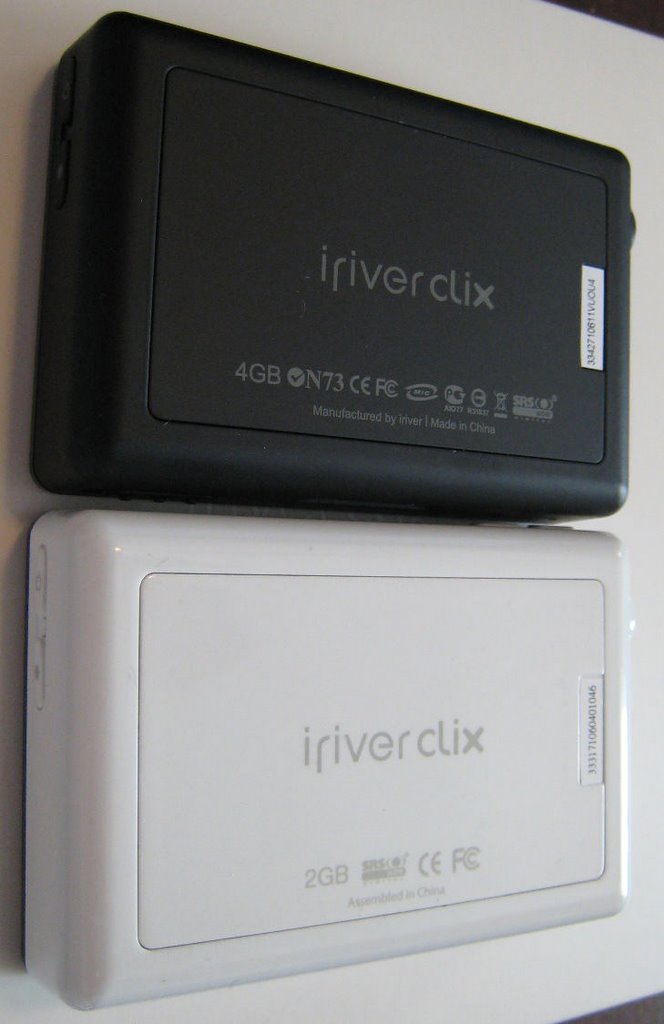
This week, I bring you the new, hot off the press Iriver Clix 4GB (the one on top in the picture below) - an update to the Iriver Clix 2GB (the one on the bottom).

This upgrade doubles the storage space and adds a black matte finish (vs the shiny white finish of the original). The extra space is well worth it, doubling the song capacity to close to 2,000 64Kbs WMA encoded songs.

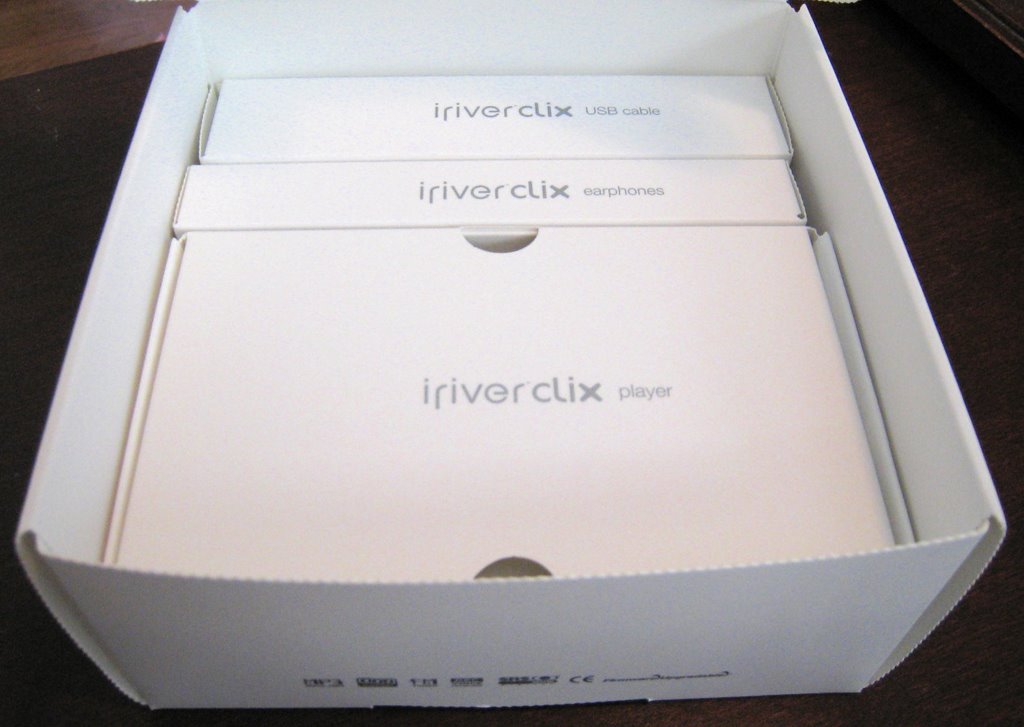
Iriver has taken a page from the Apple notebook and put together some refined packaging:

I love this thing and had fit close to 1,000 songs on the 2GB version, but was running out of room to the point where I had to be more selective about which songs to put on there. Now, I don't have this worry any more.

I've used the old Clix for about a year, flying all over the world including some fairly crazy trips and really like it... It's tiny, light, has a pretty long lasting battery (I tend to get around 10 to 12 hours vs the rated 25 hours, but that may be because I'm using WMA files vs MP3) and the sound is great. My Clix and my Bose Quietcomfort Headset put me into my own quiet, music filled world while flying.

Tags : / / / / / / /